NYSE:WMT

Walmart Completes Vibe*co Acquisition to Expand Connected TV Advertising Business

Walmart announced it has completed its acquisition of Vibe*co, a self-service connected TV (CTV) advertising platform, strengthening Walmart Connect's commerce media business and expanding its presence in streaming television advertising.

The acquisition combines Vibe*co's self-service advertising platform with Walmart Connect's retail media capabilities, enabling advertisers to plan, purchase and measure streaming TV campaigns more easily. Walmart said the deal will make connected TV advertising more accessible for businesses of all sizes while helping brands better connect advertising campaigns with measurable shopping outcomes.

Vibe*co, founded in 2021, has developed a platform used by more than 10,000 advertisers to launch streaming TV campaigns across premium publishers through simplified campaign management, flexible budgets and AI-powered optimization.

Walmart said the acquisition will enhance Walmart Connect's ability to deliver closed-loop advertising solutions by integrating first-party customer insights with streaming, digital and in-store advertising channels. The company expects the transaction to create new opportunities for suppliers, marketplace sellers and brands to reach customers throughout the shopping journey while improving campaign measurement and effectiveness.

The acquisition reflects Walmart's continued investment in its rapidly growing advertising business as retailers increasingly expand beyond traditional retail operations into high-margin retail media and digital advertising services.
Walmart Gains 1% as Investors Favor Defensive Stocks Despite Analyst Downgrade

Walmart shares rose 1% on Friday, outperforming the broader market as investors sought safety in defensive sectors during a sharp selloff that pushed major technology indexes significantly lower.

The gain came even as Erste Group Bank downgraded the stock from Buy to Hold. While downgrades often pressure shares, the market appeared more focused on Walmart's defensive characteristics and resilient business model amid growing economic uncertainty.

As concerns about higher-for-longer interest rates weighed heavily on technology and growth stocks, investors rotated into companies with stable earnings, strong cash flow, and consistent consumer demand. Walmart is widely viewed as one of the largest beneficiaries of this type of market environment due to its dominant position in grocery retailing and its ability to attract consumers across income levels.

The retailer has also strengthened its competitive position through investments in e-commerce, delivery services, advertising, and membership offerings. These higher-margin businesses have helped diversify revenue streams and improve profitability beyond traditional retail operations.

Friday's positive performance suggests investors remain confident in Walmart's ability to navigate a potentially slower economic environment. Historically, the company has performed relatively well during periods of economic uncertainty as consumers increasingly prioritize value and essential purchases.

The divergence between the analyst downgrade and the stock's gain highlights the current market dynamic. While some analysts may see more limited upside after Walmart's strong performance over recent years, investors continue to view the company as a high-quality defensive holding capable of delivering steady growth and earnings stability even as broader market volatility increases.

With interest-rate expectations remaining elevated and economic uncertainty persisting, Walmart's combination of scale, pricing power, and essential consumer exposure continues to make it an attractive destination for investors seeking stability in an increasingly turbulent market environment.
Walmart Falls 7% Despite Solid Quarter as Guidance Disappoints Investors

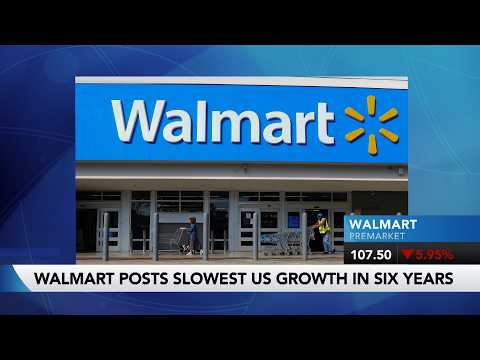
Walmart dropped 7% after the world's largest retailer reported a broadly solid first quarter but issued second quarter guidance and reiterated full-year commentary that left investors wanting more, particularly against the backdrop of a macro environment where consumer staples companies are expected to demonstrate resilience.

Revenue for Q1 came in at $177.8 billion, up 7.3% year over year or 5.9% in constant currency — a healthy topline for a company of Walmart's scale. Global eCommerce sales grew 26%, led by store-fulfilled pickup and delivery and marketplace, continuing the digital transformation that has been central to Walmart's investment thesis. The global advertising business surged 37%, with Walmart US advertising up 36%, and membership fee revenue grew 17.4% globally — both high-margin revenue streams that point to the structural evolution of the business beyond traditional retail. Gross profit rate improved 6 basis points, led by Walmart US. Operating income grew 5.0%, or 5.1% on an adjusted constant currency basis. GAAP EPS was $0.67 and adjusted EPS was $0.66.

On the surface these are respectable numbers. The issue for investors lies in what comes next. The company reiterated its full-year fiscal 2027 outlook rather than raising it, and the Q2 guidance it issued apparently failed to clear the bar a market had set following strong results from TJX and other retailers this week. Inventory was up 8.9%, partly reflecting timing of receipts and strong grocery demand, but elevated inventory levels require monitoring in a demand environment that remains uncertain.

The 7% decline is steep for a company that delivered mid-single digit operating income growth and accelerating digital revenue. It reflects a market that had priced in a guidance raise following weeks of positive retail sentiment, and found instead a company that is performing well but choosing to hold its cards rather than signal acceleration. In the current environment, where every retailer faces tariff cost pressures and consumer spending uncertainty, a reiterated rather than raised outlook was read as a cautious message regardless of the underlying momentum.
Walmart reported continued growth momentum, with revenue increasing 5.1% in constant currency to $715.9 billion and profit rising 5.4% on an adjusted basis. The company’s global eCommerce sales surged 24% to $150.4 billion, supported by strong performance across marketplace, advertising, and membership segments.

Operating cash flow reached $41.6 billion, while Walmart returned $15.6 billion to shareholders through dividends and share repurchases. The company also highlighted rapid expansion in advertising revenue and ongoing investments in technology, including AI-driven tools to enhance customer experience and operational efficiency.

Management emphasized that the integration of physical stores and digital platforms, along with supply chain innovation, continues to strengthen Walmart’s business model and support future growth.

Source: Walmart
Walmart reported continued growth momentum, with revenue increasing 5.1% in constant currency to $715.9 billion and profit rising 5.4% on an adjusted basis. The company’s global eCommerce sales surged 24% to $150.4 billion, supported by strong performance across marketplace, advertising, and membership segments.

Operating cash flow reached $41.6 billion, while Walmart returned $15.6 billion to shareholders through dividends and share repurchases. The company also highlighted rapid expansion in advertising revenue and ongoing investments in technology, including AI-driven tools to enhance customer experience and operational efficiency.

Management emphasized that the integration of physical stores and digital platforms, along with supply chain innovation, continues to strengthen Walmart’s business model and support future growth.

Source: Walmart
Walmart announced a major redesign of its flagship private label brand, Great Value, marking its first full refresh in over a decade.

The update introduces a modern visual identity aimed at improving product visibility and ease of shopping across both stores and digital platforms, while maintaining the same product quality and pricing. The redesign will cover nearly 10,000 items, making it the largest private brand update in the company’s history.

Walmart said the rollout will be phased over the next two years, starting with select product categories. The initiative is part of the retailer’s broader strategy to enhance customer experience and adapt to evolving consumer preferences, while continuing to emphasize affordability and consistency.

The company noted that Great Value products are present in most U.S. households and play a key role in delivering cost savings compared to national brands.
Walmart Inc. has launched a new business unit, Upstream Facility Services, expanding its in-house maintenance capabilities to serve external companies across the United States.

The new offering leverages Walmart’s extensive operational scale and expertise developed across its network of stores and Sam’s Club locations. Upstream will provide services including HVAC, refrigeration, electrical, plumbing, and general maintenance, targeting businesses with multi-location operations where uptime and efficiency are critical.

The service model combines urgent repairs, preventive maintenance, and predictive solutions, supported by a nationwide network of technicians positioned close to customer sites. Clients will also benefit from real-time visibility into service performance, enabling improved planning and faster decision-making.

With this move, Walmart aims to commercialize one of the largest in-house facility service operations in the country, helping businesses reduce downtime, extend asset life, and improve operational consistency.
Walmart Launches ‘The Devil Wears Prada’ Inspired Fashion Collection

Walmart has unveiled a limited-time “The Devil Wears Prada Scoop Collection,” bringing high-fashion inspiration to its affordable private-label lineup.

The collection, part of Walmart’s exclusive Scoop brand, draws on the iconic style of *The Devil Wears Prada* and features tailored blazers, structured dresses, denim sets, and statement accessories designed to reflect New York-inspired fashion trends.

Priced between $16 and $54, the range aims to deliver trend-forward styles at accessible price points. Pre-orders began on April 9 via Walmart*com, with a full launch scheduled for April 20 across online channels and select U.S. stores.

The release highlights Walmart’s ongoing strategy to expand its fashion offerings and appeal to style-conscious consumers seeking value-driven apparel.
Walmart and VIZIO announced new integrations to expand their content-to-commerce ecosystem, combining streaming, advertising, and retail data to deliver measurable outcomes for brands.

The partnership will introduce a unified account system allowing users to log into VIZIO smart TVs using Walmart credentials, enabling seamless linkage between viewing behavior and purchasing activity.

The companies also unveiled new branded content initiatives and advertising capabilities, including product placement integrations and closed-loop measurement tools, aiming to strengthen the connection between entertainment and retail commerce.
Walmart announced that digital shelf labels (DSLs) are now live in approximately 2,300 U.S. stores, with full chain-wide deployment expected within the next year.

The technology replaces paper price tags with centrally managed digital displays, allowing associates to execute approved price updates through a secure internal system. Pricing remains consistent for all customers within a store and does not vary by demand, time of day or shopper profile. Updates are typically pushed outside shopping hours to ensure price stability during the day and alignment with Walmart’s Everyday Low Price (EDLP) model.

Operational impact is the primary driver:

• Price changes that previously required manual tag replacement across tens of thousands of SKUs can now be completed in minutes.
• “Stock to Light” functionality enables associates to activate LED indicators on shelf labels to quickly locate items requiring restocking.
• “Pick to Light” supports faster and more accurate online order fulfillment by guiding associates to products during pickup and delivery preparation.

With more than 120,000 items in a typical store and thousands of weekly price adjustments, the efficiency gains reduce repetitive manual tasks and redirect labor toward customer service, merchandising standards and inventory management.

Walmart also emphasized that DSLs operate on a closed system. They do not include cameras or microphones and do not collect shopper data.

The rollout represents an operational modernization initiative focused on labor productivity, price accuracy and paper waste reduction, rather than dynamic pricing.
Video Thumbnail
08-16-26WS News
Video Thumbnail
08-14-26Global Finance News
Video Thumbnail
07-05-26WS News
Video Thumbnail
06-02-26The Investor
Video Thumbnail
05-21-26European Investor