UK

UK House Prices Rise 0.2% in August but Annual Growth Misses Forecast

UK house prices returned to monthly growth in August, although the housing market remained subdued amid elevated mortgage rates and broader economic uncertainty.

Nationwide’s House Price Index increased 0.2% month over month, beating expectations for a 0.1% rise and reversing July’s revised 0.1% decline. It was the first monthly increase since April.

On an annual basis, house prices rose 1.6%, accelerating from 1.4% in July but falling short of the 2.1% forecast provided in the economic calendar. The average UK home price stood at £275,465 in August.
Post Image
UK Services Growth Accelerates in August While Manufacturing Slows

UK business activity remained in expansion territory in August, led by stronger services growth.

The S&P Global Services PMI rose to 52.8 from 52.1, beating expectations of 51.8 and signaling an acceleration in the UK's dominant services sector.

Manufacturing was softer, with the PMI falling to 51.5 from 51.9 and slightly missing the 51.6 forecast. However, the reading remained above the 50 threshold, indicating continued expansion.

Overall, the data suggest resilient UK economic activity, with stronger services helping offset some loss of momentum in manufacturing.
Post Image
# UK Retail Sales Slow Sharply in July, Missing Forecasts

UK retail sales growth weakened significantly in July, pointing to softer consumer spending.

Headline retail sales rose 1.6% year over year, below the 2.2% forecast and sharply slower than the previous 3.8% increase.

Core retail sales, which exclude fuel, increased 2.3%, also missing expectations of 3.3% and slowing from 5.0% previously.

The weaker-than-expected figures suggest household demand lost momentum entering the second half of the year. For the Bank of England, softer consumption could reinforce concerns about economic growth and support a more cautious monetary-policy stance.
Post Image
UK Inflation Accelerates to 2.9% in July

UK inflation accelerated in July, adding to concerns that price pressures remain persistent despite signs of easing costs at the producer level.

The Consumer Price Index rose 2.9% year-over-year, matching market expectations but accelerating from 2.6% in June. On a monthly basis, consumer prices increased 0.3%, also in line with forecasts and above the previous 0.1% increase.

Producer-level pressures were considerably weaker. PPI input prices fell 1.7% month-over-month, compared with expectations for no change. The decline was slightly smaller than the previous month's 1.9% fall.

The combination presents a mixed inflation picture: businesses are seeing lower input costs, but consumer inflation is moving higher. For the Bank of England, the acceleration in headline CPI could reinforce a cautious approach toward monetary-policy easing, particularly if stronger consumer-price pressures persist in coming months.

Graph: Office for National Statistics UK
Post Image
UK Labor Market Sends Mixed Signals as Unemployment Holds at 4.9%

The UK labor market delivered mixed signals in the latest data, with unemployment remaining elevated even as the number of people claiming unemployment-related benefits declined.

The claimant count fell by 11,000 in July, considerably better than expectations for an increase of 16,500 and following a revised decline of 6,400 in the previous month.

Employment increased by 83,000 in the three months through June compared with the previous three-month period. However, the pace of employment growth slowed from 147,000 previously.

Meanwhile, the unemployment rate remained at 4.9% in June, slightly above the 4.8% market forecast and unchanged from the previous reading.

The figures suggest the UK labor market remains resilient but is gradually losing momentum. The unexpected decline in benefit claimants provides a positive signal, while slower employment growth and an unemployment rate near 5% point to softer underlying labor demand.

For the Bank of England, the mixed report keeps attention on whether cooling employment conditions will translate into weaker wage and inflation pressures, an important factor in determining the path of UK interest rates.
UK Retail Sales Growth Slows to 1% in July, Missing Expectations

UK retail sales growth weakened more than expected in July, adding to signs that consumers remain cautious despite support from summer spending and the World Cup.

The British Retail Consortium Retail Sales Monitor increased 1.0% year-over-year in July, below the 1.6% market forecast and slowing from 1.7% in June.
UK House Price Growth Slows Sharply in July as Market Stagnates

UK house prices were unchanged in July, highlighting continued weakness in the housing market as elevated borrowing costs and affordability pressures restrained demand.

The Lloyds House Price Index showed prices were flat at 0.0% month-on-month, below the 0.2% increase expected and following a 0.2% rise in June.

Annual house price growth slowed more sharply, falling to just 0.1% from a revised 0.7% in June and missing expectations for a 0.4% increase. This was the weakest annual growth rate since November 2023.
Eurozone and UK Services Activity Improves in July as Germany Returns to Near Stability

Services sector activity across Europe showed further signs of stabilization in July, with the Eurozone and the UK both posting stronger-than-expected PMI readings, while Germany's services sector moved closer to returning to expansion.

Key July Services PMI Results

Germany HCOB Services PMI: 49.8 (Expected: 49.6 | Previous: 48.6)
Eurozone HCOB Services PMI: 51.7 (Expected: 51.6 | Previous: 49.4)
UK S&P Global Services PMI: 52.1 (Expected: 51.8 | Previous: 48.8)
France HCOB Services PMI: 49.6 (Expected: 49.8 | Previous: 46.8)

The Eurozone services sector remained in expansion territory, with the PMI rising to 51.7, comfortably above the 50-point threshold that separates growth from contraction. The stronger-than-expected reading suggests demand across the region continued to recover despite lingering geopolitical uncertainty and softer manufacturing activity.

Germany also delivered an encouraging report. Although its services PMI remained just below the 50 mark at 49.8, the improvement from 48.6 indicates that the country's services sector is approaching stabilization after several months of weakness.

The UK posted one of the strongest reports among the major European economies. The Services PMI climbed to 52.1, beating expectations and rebounding sharply from 48.8 in June, pointing to renewed momentum in the country's largest economic sector.

France remained the weakest performer. While the Services PMI improved significantly from 46.8 to 49.6, it still stayed just below the expansion threshold, indicating that activity continues to contract, albeit at a much slower pace.

Overall, the July PMI releases suggest that Europe's services sector is becoming an increasingly important source of economic resilience. The data may ease concerns about slowing growth and reinforce expectations that domestic demand remains relatively healthy even as manufacturing continues to face headwinds.
UK House Price Growth Slows as Nationwide Index Misses Expectations

The UK housing market showed signs of cooling in July as annual house price growth slowed more than expected, suggesting higher borrowing costs and affordability pressures continue to weigh on property demand.

According to Nationwide, house prices rose 0.1% month over month in July, matching market expectations and improving from a flat reading in June. However, annual house price growth slowed to 1.8%, below economists' expectations of 1.9% and down from 2.2% in June.
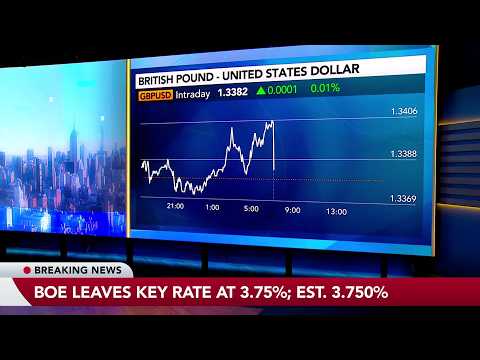
Bank of England Holds Interest Rate at 3.75% as Expected

The Bank of England kept its benchmark interest rate unchanged at 3.75% on Thursday, matching market expectations and maintaining the policy rate at its current level.
Video Thumbnail
08-29-26WS Investor
Video Thumbnail
08-17-26WS Investor
Video Thumbnail
06-22-26WS Investor
Video Thumbnail
04-30-26Global Finance News
Video Thumbnail
04-30-26WS Investor