NYSE:F

Ford Stock Rises 5% in Premarket as Higher Full-Year Guidance Overshadows Quarterly Loss

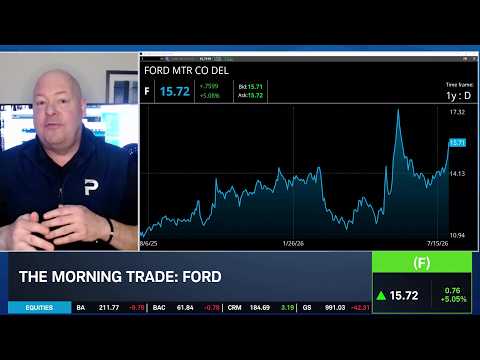
Ford Motor (NYSE: F) shares climbed 5% in Wednesday's premarket trading after the automaker raised its full-year earnings and free cash flow guidance, with investors looking past a reported quarterly net loss that was largely driven by one-time charges.

Ford reported second-quarter revenue of $48.3 billion, down 4% from a year earlier due to lower wholesale volumes, discontinued products, aluminum supply constraints, and lower production of first-generation electric vehicles. The company posted a net loss of $1.3 billion, or $0.33 per share, primarily because of a $3.6 billion largely non-cash charge related to the previously announced disposition of the BlueOval SK joint venture, along with charges tied to canceled EV programs.

Excluding these one-time items, underlying performance improved. Adjusted EBIT rose to $2.5 billion from $2.1 billion a year earlier, while adjusted EPS increased to $0.42 from $0.37. Adjusted EBIT margin also expanded to 5.2% from 4.3%, reflecting stronger profitability and improved operating discipline.

The biggest catalyst for the stock was Ford's upgraded full-year outlook. The company raised its 2026 adjusted EBIT guidance to $10.0 billion-$11.0 billion from the previous range of $8.5 billion-$10.5 billion. It also lifted adjusted free cash flow guidance to $6.0 billion-$7.0 billion from $5.0 billion-$6.0 billion, signaling growing confidence in the business despite ongoing macroeconomic uncertainty.

Management highlighted strong pricing power for its truck, off-road, and hybrid vehicle lineup, improving product quality, and expanding higher-margin businesses such as Ford Energy. The company also generated $4.3 billion in operating cash flow during the quarter, ended the period with $22.3 billion in cash and $43.4 billion in liquidity, and declared a quarterly dividend of $0.15 per share.

The strong premarket rally reflects investors' focus on Ford's improving underlying profitability and significantly higher full-year guidance rather than the headline net loss, which was largely attributable to non-cash accounting charges. The results reinforce management's view that operational improvements and disciplined cost management are beginning to translate into stronger earnings power.
Ford Surges 13% as Morgan Stanley Calls It an AI Energy Stock

May 13, 2026 | NYSE: F

Ford is one of today's most talked-about names on Wall Street, with shares surging as much as 13% — and the reason has nothing to do with trucks.

Ford soared on Morgan Stanley's positive comments about its energy business. The bank noted that Ford recently secured a license from China's CATL, the world's largest battery manufacturer, giving it the right to produce batteries in the US — not for electric cars, but for energy storage systems targeting large commercial customers and potentially AI hyperscalers. (The Motley Fool)

Morgan Stanley's analyst described Ford's CATL tie-up as "an underappreciated strategic competitive advantage," estimating Ford Energy could generate $500 million to $600 million in run-rate annual EBIT from 20 gigawatt-hours of output. (ts2*tech)

Ford plans to invest approximately $2 billion to scale the business, targeting annual deployments of at least 20 GWh by 2027, with systems assembled in Kentucky. The move followed a reported $19.5 billion cumulative loss in Ford's EV division, prompting a strategic shift toward repurposing underutilized EV battery manufacturing capacity for the energy storage market — supplying utilities, data centers, and heavy industry instead. (StockStory / FinancialContent)

The energy pivot lands on top of an already strong earnings backdrop. Ford's Q1 delivered $43.3 billion in revenue, adjusted EPS of $0.66 that crushed the $0.19 consensus estimate, and a raised full-year EBIT guidance range of $8.5 to $10.5 billion. Ford Pro, the commercial vehicle segment, contributed $1.69 billion in EBIT with paid software subscriptions up 30% to 879,000.

Morgan Stanley is penciling in Ford Energy announcing one or more large customer deals "over the next few months," and points to Tesla's energy business — which generates profit margins twice as high as its car business — as a potential reference point for what Ford could build. (The Motley Fool)

For a stock that was down 9% year to date, today's move represents a meaningful narrative shift — from struggling EV laggard to potential AI infrastructure play.
Ford Motor Company reported strong first-quarter 2026 results and raised its full-year guidance, supported by favorable pricing, product mix, and software-driven revenue.

Revenue reached $43.3 billion, while net income came in at $2.5 billion and adjusted EBIT totaled $3.5 billion. The results included a $1.3 billion one-time tariff-related benefit, which boosted profitability during the quarter.

Operating cash flow was $1.3 billion, though adjusted free cash flow showed a use of $1.9 billion. The company also declared a quarterly dividend of $0.15 per share.

Looking ahead, Ford raised its full-year adjusted EBIT guidance to a range of $8.5–$10.5 billion, up from the previous $8.0–$10.0 billion outlook, reflecting confidence in ongoing execution and cost improvements.

Management highlighted continued progress in its Ford+ strategy, focusing on higher-margin products, software and services growth, and improving electric vehicle profitability.

Source: Company press release
Dearborn, Mich., April 15, 2026 — Ford Motor Company announced the creation of a new Product Creation and Industrialization organization aimed at accelerating the development and scaling of next-generation vehicles and technologies.

The new unit integrates Ford’s electric vehicle, digital, design, and global industrial teams into a single structure, with the goal of speeding up decision-making, reducing complexity, and supporting the company’s Ford+ strategy, including a target of achieving an 8% adjusted EBIT margin by 2029.

Ford plans a major product renewal, aiming to refresh 80% of its North American portfolio and 70% of its global lineup by volume by 2029, alongside expanding electrification across nearly 90% of its nameplates by 2030. The initiative also supports the rollout of software-defined vehicles, over-the-air updates, and advanced driver assistance technologies.

The restructuring comes with leadership changes, including the departure of Chief EV and Digital Officer Doug Field, while COO Kumar Galhotra will lead the new organization.

Ford said the move positions the company to scale digital innovation, electrification, and manufacturing efficiency as it transitions toward a more software-driven automotive future.
Ford Motor Company reported a higher U.S. retail market share in Q1 2026, supported by strong demand for trucks and large SUVs despite an overall decline in total sales.

Ford’s retail share rose to 11.6%, up 0.2 percentage points, driven by double-digit growth in high-margin SUV models such as Explorer and Expedition. Combined sales of key SUVs increased 17.9%, while Expedition sales jumped 30.2% and Explorer rose nearly 30%.

The Ford F-Series maintained its position as America’s best-selling truck, with 159,901 units sold, reinforcing Ford’s long-standing leadership in the segment. Total pickup and van sales reached 257,475 vehicles, while the Ford Transit remained the top-selling van.

However, total vehicle sales declined 8.8% year-over-year, reflecting product transitions and tough comparisons with a strong prior-year period. Ford said it is focusing on a more profitable product mix, emphasizing SUVs, trucks, and commercial vehicles.

The company also highlighted growth in its software and technology segment, with Ford Pro subscriptions rising about 29% to over 865,000, and its BlueCruise hands-free driving system surpassing 10 million cumulative usage hours.

Tesla Model Y outsells everything in three states, but Ford dominates

The Tesla Model Y was the best-selling vehicle in three different states in the U.S. last year, according to new data that shows the all-electric crossover outsold every other car in a few places.

(teslarati.com)
Ford Motor Company reported fourth-quarter and full-year 2025 results marked by revenue growth but significant GAAP losses tied to special items.

Fourth-quarter revenue was $45.9 billion, contributing to full-year revenue of $187.3 billion, the company’s fifth consecutive year of annual growth. However, Ford posted a net loss of $11.1 billion in Q4 and $8.2 billion for the full year, reflecting the impact of special items. On an adjusted basis, fourth-quarter EBIT was $1.0 billion and full-year adjusted EBIT totaled $6.8 billion.

For 2025, operating cash flow reached $21.3 billion, while adjusted free cash flow was $3.5 billion.

Looking ahead to 2026, Ford expects adjusted EBIT of $8.0 billion to $10.0 billion and adjusted free cash flow of $5.0 billion to $6.0 billion. Capital expenditures are projected between $9.5 billion and $10.5 billion.

Management highlighted ongoing efforts to improve quality, reduce material and warranty costs, enhance EV profitability, and strengthen capital discipline as key drivers for margin expansion toward its 8% adjusted EBIT margin target by 2029.

Source: Company press release (Feb. 10, 2026).

Ford Q4 earnings preview: EV losses, F-150 pickup business crucial for investors

Big Three automaker Ford is on deck to report fourth quarter results Tuesday after the bell, with particular focus on its EV business and the effects of an aluminum plant fire that impacted Ford’s franchise F-150 sales.

(finance.yahoo.com)
Ford Motor Company and Ford Motor Credit Company
will release fourth-quarter and full-year 2025 financial results at 4:05 p.m. ET on Tuesday, Feb. 10.
Ford Motor Company reported a strong sales performance in 2025, with total vehicle sales rising 6% year over year to 2.20 million units, marking its highest annual sales result of the decade. The automaker also gained market share, with its full-year U.S. share increasing by 0.6 percentage points to 13.2%, supported by robust demand for trucks, hybrids and commercial vehicles.

Ford’s momentum was driven primarily by its truck and utility lineup. The F-Series extended its long-standing leadership, securing its 49th consecutive year as America’s best-selling truck and its 44th year as the country’s best-selling vehicle overall, with sales climbing 8.3% to 828,832 units. Hybrid demand was another standout, as Ford sold a record 228,072 hybrid vehicles in 2025, delivering the strongest fourth-quarter hybrid results in the company’s history.

Several nameplates achieved record or category-leading results during the year. The Explorer retained its position as the best-selling three-row SUV in the U.S., while the Bronco posted a new annual sales record. In the commercial segment, the Ford Pro Transit Van set a new annual high with 161,797 units sold, and Ford maintained its status as America’s number one commercial vehicle seller for the 47th consecutive year. The Maverick also delivered a record year, with 155,051 pickups sold, reinforcing Ford’s appeal in the affordable truck segment.

Beyond vehicle sales, Ford highlighted growing contributions from software and advanced technology. Ford Pro Intelligence paid software subscriptions rose about 30% year over year in the fourth quarter to roughly 840,000 active subscriptions, while BlueCruise hands-free driving surpassed 8.5 million cumulative hours on U.S. highways. Management said the results underscore the effectiveness of Ford’s broad product range and powertrain strategy, positioning the company to continue outperforming the industry as it enters 2026.
Video Thumbnail
07-29-26The Investor
Video Thumbnail
07-29-26The Investor
Video Thumbnail
06-26-26Global Finance News
Video Thumbnail
06-14-26Global Finance News
Video Thumbnail
05-14-26WS Investor