NYSE:IBM

IBM’s Anderon Finalizes $1 Billion U.S. CHIPS Award for Quantum Foundry

IBM (NYSE: IBM) subsidiary Anderon has finalized a $1 billion CHIPS and Science Act award with the U.S. Department of Commerce to accelerate research and development for quantum wafer manufacturing in the United States. The agreement follows the $1 billion proposed award announced in May.

Anderon operates a 300-millimeter pure-play quantum wafer foundry in Albany, New York, supported by an additional $1 billion investment from IBM. The facility is designed to manufacture specialized wafers for superconducting qubit arrays, quantum input/output signaling and readout components, with plans to support additional quantum technologies over time.

The company has already begun running its first quantum wafers through the facility, marking an early step toward production-scale manufacturing. The foundry is intended to serve IBM as well as other quantum technology companies, potentially expanding the domestic supply chain for quantum hardware.

The investment also supports IBM’s broader quantum strategy. IBM has committed more than $10 billion to quantum computing over five years and is working toward large-scale fault-tolerant quantum systems, making scalable wafer manufacturing an important part of its long-term technology roadmap.
IBM and Lockheed Martin Launch Swiss Quantum Innovation Hub at ETH Zurich

IBM and Lockheed Martin have established a new quantum innovation hub at ETH Zurich that will host Switzerland’s first IBM Quantum System Two, expanding access to advanced quantum computing for Swiss universities, industries and startups.

The system will be installed at the Swiss National Supercomputing Centre in Lugano and operated by IBM. It will use IBM’s Quantum Nighthawk processor, while ETH Zurich will provide expertise and resources to support research, workforce development and new industrial applications. Deployment is expected by the end of 2026.

Organizations participating in the hub will initially gain access to IBM’s existing quantum computers through the cloud before receiving access to the dedicated Swiss system. Potential applications include chemistry, materials science, optimization and financial services.

The initiative also expands the existing IBM-Lockheed Martin partnership. The companies plan joint research projects exploring quantum sensing for navigation and the use of advanced technologies to improve additive manufacturing of metallic alloys, with potential applications in aerospace and defense.
IBM Completes HRL Laboratories Acquisition to Strengthen Quantum Computing Roadmap

IBM (NYSE: IBM) has completed its acquisition of HRL Laboratories, bringing additional expertise in quantum computing, quantum sensing, materials science and advanced semiconductor technologies into IBM’s expanding quantum ecosystem.

The deal combines IBM’s leadership in superconducting quantum computing with HRL’s expertise in silicon-spin qubits, giving IBM exposure to complementary approaches to quantum hardware as it works toward large-scale, fault-tolerant quantum systems.

HRL Adds New Capabilities to IBM’s Quantum Platform

HRL Laboratories brings research capabilities spanning silicon-spin qubits, quantum sensing, quantum materials, cryogenics, control electronics, advanced packaging and interconnect technologies.

The silicon-spin expertise is particularly notable because IBM’s current quantum systems are primarily based on superconducting qubits. Adding HRL therefore broadens IBM’s technical capabilities rather than simply expanding its existing architecture.

HRL’s work in cryogenics, electronics and packaging could also contribute to solving some of the engineering challenges involved in scaling quantum computers from experimental systems toward commercially useful machines.

Acquisition Supports IBM’s Fault-Tolerant Quantum Roadmap

The transaction comes as IBM pushes toward its planned IBM Quantum Starling system, a fault-tolerant quantum computer targeted for 2029. IBM expects Starling to perform 100 million quantum operations, representing a major increase in computational capability compared with current systems.

Starling is expected to be followed by Blue Jay, IBM’s next-generation fault-tolerant system targeted for the mid-2030s.

HRL’s technology could support that roadmap across several layers of the quantum stack, particularly hardware design, materials, control systems and manufacturing.

The acquisition also complements IBM’s investment in quantum manufacturing. HRL’s silicon-based quantum technologies could eventually work alongside Anderon, IBM’s pure-play quantum wafer foundry, potentially allowing IBM to accelerate development and manufacturing across multiple quantum-computing architectures.

Why the Acquisition Matters for IBM

The deal reinforces IBM’s position as one of the major companies pursuing commercially viable quantum computing. More importantly, IBM is expanding beyond a single technological approach by combining its superconducting-qubit expertise with HRL’s silicon-spin capabilities.

That diversification could become strategically important because the industry has not yet established which qubit architecture — or combination of architectures — will ultimately provide the best path toward scalable fault-tolerant quantum computing.

The acquisition also preserves important industrial relationships. Boeing and General Motors, HRL’s former owners, will continue working with IBM and HRL on quantum applications and advanced technology development.

For IBM, the transaction is therefore more than an expansion of its research organization. It adds complementary quantum technologies, specialized engineering expertise and industrial partnerships as the company works toward its ambitious 2029 fault-tolerant quantum computing target.
IBM Unveils First Dual-Architecture Mainframe Processor, Bringing Arm to IBM Z and LinuxONE

IBM (NYSE: IBM) unveiled a next-generation processor designed to run both IBM and Arm architectures natively, marking a significant expansion of the company's mainframe strategy as enterprises increasingly deploy cloud-native and AI workloads.

Announced at the Hot Chips conference, the processor is being developed for future IBM Z and LinuxONE systems and represents the first major processor milestone from IBM's collaboration with Arm, established in April 2026.

IBM brings Arm ecosystem to the mainframe

The key innovation is that IBM is not simply placing separate Arm and IBM cores on the same chip. Each processor core is designed to execute Arm and IBM Z—or Arm and LinuxONE—instructions natively and concurrently.

That could allow customers to run Arm-native Linux environments alongside traditional z/OS and Linux workloads on IBM's enterprise systems.

The strategy gives IBM access to Arm's large software ecosystem, which includes more than 22 million developers and an expanding range of cloud-native and AI applications. For enterprises, it could reduce barriers to bringing newer applications onto infrastructure traditionally associated with mission-critical transaction processing.

2nm processor targets AI and high-performance workloads

IBM said the processor is being built on a 2-nanometer process and will feature 11 high-performance cores operating above 5.7 GHz.

It will also incorporate AI inference accelerators capable of supporting applications such as real-time fraud detection during transactions, along with a dedicated on-chip data processing unit for I/O acceleration and a large cache architecture.

The combination is particularly relevant to IBM's position in banking, insurance, government and other highly regulated industries, where customers increasingly want to integrate AI into core workloads without moving sensitive applications away from highly secure enterprise infrastructure.

Why it matters for IBM

The announcement strengthens IBM's effort to modernize its mainframe franchise rather than treating it as a legacy computing business. Native Arm compatibility potentially broadens the pool of applications that can run on IBM Z and LinuxONE while preserving the security, encryption, reliability and scalability that differentiate those systems.

It could also make IBM's infrastructure more relevant to the AI ecosystem. Arm architecture has expanded rapidly across cloud and AI computing, and combining that ecosystem with IBM's enterprise installed base could create additional opportunities for application modernization and AI deployment.

The processor remains a future technology rather than an immediate revenue catalyst, but strategically it represents an important architectural shift for IBM. By opening Z and LinuxONE to Arm-native applications, IBM is positioning its flagship enterprise systems to participate more directly in the convergence of traditional mission-critical computing, cloud-native software and AI.
IBM Connects Modular Cryogenic Systems in Step Toward Fault-Tolerant Quantum Computing

IBM has reached a major engineering milestone in its quantum computing roadmap by successfully connecting and cooling two modular cryogenic systems designed to support increasingly large networks of quantum processors.

The connected modules reached temperatures below 15 millikelvin, more than 180 times colder than deep space. Each module also provides up to 12 times more wiring space than IBM’s most widely used quantum systems, enabling substantially more connections between quantum chips.

The architecture is designed to work with IBM’s L-coupler technology, which connects separate quantum processors so they can communicate and operate as part of a larger system. IBM plans to use this approach to build a quantum computer with at least 1,000 programmable qubits by 2027 and will install its Nighthawk processors in the new cryogenic modules later this year for additional testing.

The development is another step toward IBM Quantum Starling, which IBM plans to deliver in 2029 as the world’s first large-scale fault-tolerant quantum computer. Fault tolerance is considered a critical requirement for commercially useful quantum computing because it allows systems to detect and correct errors while performing complex calculations.
# IBM Partners With OpenAI to Expand Enterprise AI Deployment

IBM (NYSE: IBM) announced a strategic partnership with OpenAI aimed at accelerating secure AI adoption across large enterprises and highly regulated industries.

The collaboration will integrate OpenAI frontier models, including GPT-5.6, along with Codex and ChatGPT Work, into IBM Consulting Advantage. The companies will jointly target areas including financial services, government, telecommunications and retail.

## IBM Expands Its Enterprise AI Position

IBM is also launching a dedicated OpenAI Practice, with thousands of consultants and engineers expected to receive advanced OpenAI Partner Network certifications. Specialized teams will work directly with customers to modernize legacy applications and integrate AI into finance, procurement, customer operations and HR workflows.

Cybersecurity is another major component. IBM and OpenAI plan to combine frontier AI capabilities with IBM Autonomous Security to address cyber threats, AI model risks and governance challenges.

The partnership strengthens IBM’s position as an enterprise AI implementation and consulting provider, combining OpenAI’s models with IBM’s established presence in large organizations, legacy systems and regulated industries. It could also support growing demand for IBM Consulting as enterprises move from experimental AI projects toward large-scale production deployments.
IBM Expands AI Infrastructure Push With $240 Million Together AI Agreement

IBM (NYSE: IBM) announced a multi-year $240 million agreement with Together AI to deploy a large-scale artificial intelligence inference cluster on IBM Cloud, further expanding the company’s exposure to growing enterprise AI infrastructure demand.

Under the agreement, IBM plans to deploy NVIDIA HGX B300 systems combined with NVIDIA Spectrum-X Ethernet networking. The cluster, expected to become available in the first quarter of 2027, will be used by Together AI to provide production-scale inference for open-source AI models.

The deployment will be IBM Cloud’s first dedicated large-scale inference cluster based on HGX B300 systems. NVIDIA says the architecture can deliver as much as 30 times greater AI factory output compared with previous generations.

Together AI has been scaling rapidly as demand for open-source AI models grows. The company says its inference platform currently processes around 400 trillion tokens per month and recently raised $800 million at an $8.3 billion valuation.

For IBM, the agreement strengthens its position as an infrastructure provider for increasingly compute-intensive AI workloads. It also deepens IBM’s existing relationship with NVIDIA, spanning GPUs, networking, cloud infrastructure and enterprise AI software.

The $240 million multi-year commitment provides IBM with another significant AI infrastructure customer while demonstrating demand for its GPU-based cloud capacity. The companies expect the platform to help enterprises run open-source AI models with improved performance and lower inference costs.
# IBM Launches Apptio AI Value & ROI to Help Enterprises Measure Returns on AI Spending

IBM (NYSE: IBM) has introduced Apptio AI Value & ROI, a new set of capabilities designed to help enterprises connect their growing artificial intelligence spending with measurable business outcomes.

The platform gives technology and finance executives a centralized view of AI initiatives, including token consumption and other costs, while tracking their impact across areas such as revenue, productivity, operating costs, speed and risk.

## IBM Targets Growing AI ROI Challenge

IBM is positioning the product around a major challenge facing companies investing heavily in artificial intelligence: determining whether that spending is actually producing sufficient financial and operational returns.

Apptio AI Value & ROI allows organizations to assign specific business metrics to individual AI projects, including cost savings, conversion rates, cycle times and incident volumes. Companies can then compare baseline, target and actual results to determine whether expected value is being realized.

The platform integrates with IBM Cloudability and Apptio AI TCO & Usage, allowing customers to incorporate token spending, technology infrastructure, usage and labor costs into their calculations.

This provides enterprises with a more complete view of both the total cost of an AI initiative and the business value it generates.

IBM cited Gartner research indicating that 84% of finance leaders have been unable to measure the return on investment from AI initiatives, highlighting the growing need for tools that connect AI adoption with financial accountability.

IBM Apptio AI Value & ROI is currently available in public preview for Apptio Costing Standard and Apptio AI TCO & Usage customers. General availability is planned for the third quarter of 2026.

The launch expands IBM's enterprise AI management portfolio at a time when companies are increasingly shifting their focus from simply adopting AI technologies toward demonstrating measurable returns from those investments.
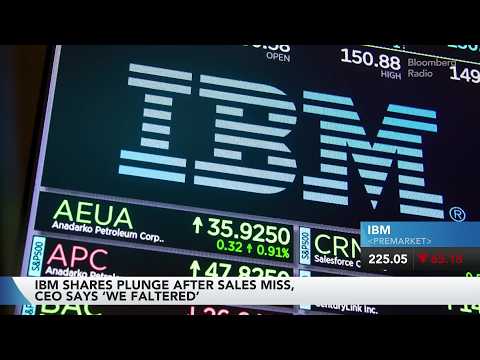
IBM Stock Plunges 25% After Preliminary Results Reveal Infrastructure Weakness

IBM (NYSE: IBM) shares tumbled roughly 25% in Tuesday trading after the company released preliminary second-quarter results that fell short of investor expectations, citing weaker-than-expected mainframe performance and delayed customer spending.

IBM reported second-quarter revenue of $17.2 billion, up 1% year over year. Software revenue increased 5%, while Consulting revenue was flat, or up 1% in constant currency. However, Infrastructure revenue declined 7%, significantly weighing on overall results.

Management attributed the weakness primarily to disappointing IBM Z mainframe sales and the associated transaction processing software business. CEO Arvind Krishna said many customers redirected capital spending toward servers, storage, and memory purchases to secure supply-constrained infrastructure ahead of expected price increases. The company also cited rapidly evolving cybersecurity concerns that delayed several large customer deals during the final weeks of June.

Profitability also weakened during the quarter. Gross margin declined to 57.7% from 58.8% a year earlier, while GAAP diluted EPS fell 2% to $2.27. Despite the disappointing quarter, operating (non-GAAP) EPS increased 5% to $2.93, and IBM generated $4.8 billion in free cash flow during the first six months of 2026.

Management emphasized that several parts of the business continued to perform well. Red Hat revenue accelerated to 11% growth, recent acquisitions including HashiCorp and Confluent delivered strong results, and Distributed Infrastructure revenue surged 37%. IBM also highlighted its recently announced Lightwell AI platform and ongoing investments in quantum computing as key long-term growth drivers.

Nevertheless, investors focused on the weaker Infrastructure performance and management's admission that several large deals failed to close as expected. The preliminary results raised concerns about IBM's near-term execution and growth outlook, triggering one of the stock's sharpest single-day declines in recent years. Investors will look for additional details when IBM reports its full second-quarter results and updates its full-year guidance on July 22.
IBM (NYSE: IBM) climbed 4.2% after receiving a series of positive analyst actions, highlighted by JPMorgan upgrading the stock to Overweight from Neutral and raising its price target to $291 from $270. RBC Capital also reiterated its Outperform rating, while Morgan Stanley established a $267 price target.

The strong move comes as investors continue to favor software and enterprise technology companies with meaningful exposure to artificial intelligence. IBM has increasingly positioned itself as a beneficiary of growing AI adoption through its watsonx platform, consulting business, and hybrid cloud offerings.

Unlike many semiconductor stocks that faced pressure during Tuesday's technology selloff, IBM attracted investor interest as a more defensive AI play with recurring software and services revenue. The company is also benefiting from growing demand for enterprise AI solutions as organizations look to deploy generative AI applications across their operations.

The analyst upgrades suggest Wall Street sees further upside in IBM's AI strategy and its ability to convert growing demand into revenue growth. The stock's gain reflects increasing confidence that IBM can benefit from the AI investment cycle while offering a more stable earnings profile than many higher-growth technology companies.
Video Thumbnail
07-14-26WS News
Video Thumbnail
07-09-26WS News
Video Thumbnail
06-23-26WS News
Video Thumbnail
06-02-26European Investor
Video Thumbnail
05-24-26The Investor