NASDAQ:WDAY

Workday Stock Falls 2.9% After BTIG Downgrades WDAY to Neutral

Workday (NASDAQ: WDAY) shares fell about 2.9% on Monday after BTIG Research downgraded the enterprise software company to Neutral from Buy.

BTIG analyst Allan Verkhovski issued the downgrade with Workday shares trading around $192.97. The move represents a notable shift in the firm’s view of the stock, as BTIG previously maintained a bullish Buy recommendation.

The downgrade likely reflects increasing caution around Workday’s near-term growth and valuation outlook. The company remains a major player in cloud-based human capital management and financial software, but enterprise software companies face greater scrutiny over their ability to translate artificial intelligence investments into faster revenue growth.

Workday is integrating AI and agentic capabilities across its platform, giving the company exposure to the broader enterprise AI transition. However, competition remains intense as major software vendors increasingly embed generative AI and automation into their own enterprise platforms.

Monday’s 2.9% decline suggests investors are reacting negatively to BTIG’s change in stance. With the rating moving directly from Buy to Neutral, the market may view the downgrade as a signal that Workday’s current risk-reward profile has become less attractive despite its long-term position in enterprise cloud software.
Workday Jumps 5% as AI Agent Adoption Accelerates and Margin Guidance Raised

Workday climbed 5% today after the enterprise software platform reported a strong fiscal first quarter that beat on revenue, showed accelerating AI adoption across its customer base and delivered a margin guidance raise that gave investors confidence the company's profitability expansion story remains on track.

Total revenues for Q1 fiscal 2027 grew 13.5% to $2.542 billion, with subscription revenues — the highest quality, most recurring component — growing 14.3% to $2.354 billion. Non-GAAP operating income rose to $809 million, representing a non-GAAP operating margin of 31.8%, up 160 basis points from 30.2% a year ago. Non-GAAP diluted EPS grew to $2.66 from $2.23. Operating cash flow surged to $696 million from $457 million, and free cash flow reached $616 million from $421 million — a 46% increase that underscores the business's powerful cash generation.

The AI story was the highlight beyond the headline numbers. The number of customers using Workday's organically developed agents more than doubled quarter over quarter, with over 4,000 customers now using at least one agent to support business processes. In Q1, Workday's Recruiting Agent supported 14 million hiring processes, up 44% year over year. The company also launched Sana, its superintelligence for work platform, now available globally, and introduced Sana for IT Service Management and a new Travel Agent. The Workday Agent System of Record is now generally available, giving customers visibility and control over all their AI agents — a feature that positions Workday as the governance layer for enterprise AI deployment rather than just another AI vendor.

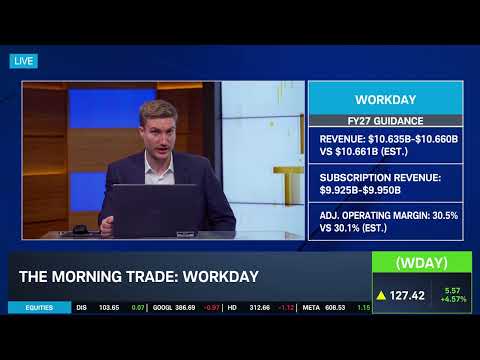
The forward-looking metrics reinforced the confidence. Twelve-month subscription revenue backlog grew 15.5% to $8.806 billion and total subscription revenue backlog rose 10.9% to $27.294 billion, providing strong visibility into future revenues. The company reiterated its full-year subscription revenue guidance of $9.925 billion to $9.950 billion representing 12% to 13% growth, while raising its non-GAAP operating margin guidance to 30.5% from the prior level — the move that most directly drove the positive market reaction.

The company repurchased approximately 12 million shares for $1.6 billion in the quarter and ended with $4.353 billion in cash and marketable securities, demonstrating both financial confidence and a commitment to returning capital.

The 5% gain reflects a market that found in Workday exactly what it has been looking for from enterprise software companies — genuine AI monetization with real customer adoption metrics, expanding margins and a durable recurring revenue base that compounds reliably regardless of the macro backdrop.
Workday Inc. announced the launch of a new AI-powered Personnel Action Request (PAR) Agent aimed at modernizing federal HR processes and improving operational efficiency.

The PAR Agent automates routine HR workflows such as hiring, promotions, and pay changes, reducing processing cycle times by up to 60% and improving decision accuracy. The tool also introduces real-time tracking and automated validation to minimize errors and ensure compliance with federal policies.

Workday said the solution could significantly lower administrative costs and improve workforce management, with potential annual savings of millions of dollars for large agencies. The PAR Agent is expected to be available to customers in 2027.

Source: Workday press release, PRNewswire
Workday Inc. Launches “Sana” AI Platform to Automate Enterprise Workflows

Workday Inc. announced the global launch of “Sana,” a new AI-powered platform designed to automate workflows, execute tasks, and unify enterprise systems through a conversational interface.

Sana integrates directly into Workday’s core HR and finance platform, enabling users to find information, take actions, build reports, and automate multi-step workflows using AI agents grounded in company data and security policies. The platform includes a self-service agent with over 300 skills already handling routine HR and finance tasks, as well as “Sana Enterprise,” which connects with external applications such as Gmail, Salesforce, and Microsoft Outlook to execute work across systems.

The launch reflects Workday’s strategy to embed AI into core enterprise operations, aiming to improve productivity, reduce manual processes, and position conversational AI as the primary interface for managing business workflows.
PRNewswire
Fairview Health Services has selected Workday to modernize its HR, finance, and supply chain systems using a unified AI-powered platform, replacing aging legacy systems.

The multi-year transformation initiative will move the healthcare provider’s 34,000 employees onto an integrated digital platform designed to streamline operations, centralize employee data, and improve financial and supply chain visibility. Workday’s Human Capital Management, Financial Management, and Supply Chain Management tools will support more efficient workflows and provide AI-driven insights to improve decision-making.

The move is intended to strengthen Fairview’s operational foundation and enable caregivers to focus more on patient care while improving efficiency and long-term financial sustainability.

PRNewswire
Workday, Inc. reports double-digit revenue growth in fiscal 2026

Workday announced fiscal 2026 fourth-quarter revenue of $2.532 billion, up 14.5% year over year, driven by subscription revenue of $2.360 billion, which rose 15.7%. Operating income increased to $174 million from $75 million a year earlier, while non-GAAP operating income reached $774 million, representing 30.6% of revenue. Diluted earnings per share were $0.55, with non-GAAP EPS of $2.47.

For the full fiscal year ended January 31, 2026, total revenue climbed 13.1% to $9.552 billion, including subscription revenue of $8.833 billion, up 14.5%. Operating income rose to $721 million, compared with $415 million in fiscal 2025, though results were impacted by $303 million in restructuring expenses. Non-GAAP operating income totaled $2.824 billion, or 29.6% of revenue. Operating cash flow increased 19.4% to $2.939 billion, while free cash flow rose 26.7% to $2.777 billion.

Workday reported total subscription backlog of $28.101 billion, up 12.2% year over year, and repurchased approximately 12.8 million shares for $2.9 billion during the year. The company expects fiscal 2027 subscription revenue of $9.925 billion to $9.950 billion, reflecting 12% to 13% growth, and projects a non-GAAP operating margin of about 30%.

Source: PR Newswire
Workday announced an immediate CEO transition as co-founder and executive chair Aneel Bhusri returned to the chief executive role, marking a leadership shift as the company positions itself for its next phase focused on artificial intelligence. Carl Eschenbach stepped down after leading the company through a period of global expansion, operational scaling, and increased discipline, and will remain involved as a strategic advisor to the CEO. The board emphasized Bhusri’s vision, deep cultural ties to the company, and suitability to lead Workday in what it described as a defining AI-driven era for enterprise software. The transition coincides with the start of Workday’s fiscal year 2027. Separately, the company reaffirmed that its fiscal 2026 fourth-quarter and full-year results are expected to be in line with previously issued guidance, with the exception of GAAP operating margin, and confirmed it will report full results on February 24, 2026.

Source: PRNewswire, February 9, 2026
Workday Announces Date of Fiscal 2026 Fourth Quarter and Full Year Financial Results on February 24th, 2026
Workday announced plans to invest CAD $1 billion in Canada over the next five years to expand its Canadian operations, grow local technology talent, and strengthen support for its rapidly expanding customer base. The investment will focus on areas such as AI development, engineering, product innovation, and customer support, reinforcing Canada’s role as one of Workday’s largest global markets, with more than 1,100 employees and over 500 customers.

As part of the initiative, Workday will also join Canada’s “With Glowing Hearts” reservist registry, committing to support Canadian Armed Forces reservists through protected leave and flexible work arrangements. The company currently operates offices across Toronto, Vancouver, Victoria, Montreal, and Calgary, providing services in both Canadian English and French, and aligning its growth strategy with Canada’s push toward responsible AI and digital self-reliance.

Source: Workday press release via PRNewswire, January 20, 2026.
Workday released new global research indicating that many companies are failing to fully realize the productivity and return-on-investment benefits of artificial intelligence. While 85% of employees report saving one to seven hours per week using AI tools, nearly 40% of those time savings are lost to rework, such as correcting errors, rewriting content, and verifying low-quality AI output. The study highlights that organizations achieving stronger AI outcomes are those that reinvest saved time into employee development, skills training, and role redesign, rather than simply increasing workloads or focusing solely on additional technology investments.

According to the findings, aligning AI adoption with workforce upskilling and modernized job structures is critical to converting AI-driven speed into sustained business value.

Source: Workday press release via PR Newswire, January 14, 2026
Video Thumbnail
08-17-26WS Investor
Video Thumbnail
08-15-26The Investor
Video Thumbnail
05-22-26European Investor
Video Thumbnail
05-22-26European Investor
Video Thumbnail
05-21-26European Investor