

NYSE:TSM

### TSMC (TSM) Rebounds in Premarket After Citigroup Reiterates Buy Rating

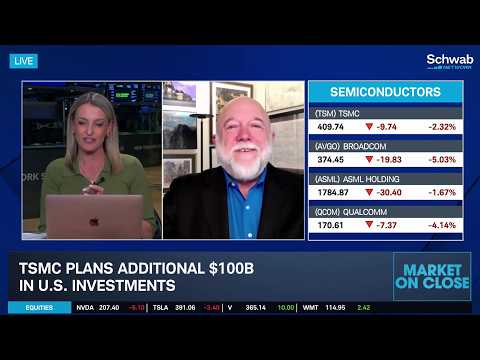
Taiwan Semiconductor Manufacturing Co. (NYSE: TSM) rebounded in premarket trading on Monday after Citigroup reiterated its Buy rating on the chipmaker, helping restore investor confidence following Thursday's selloff.

TSMC shares fell 2.3% during Thursday's regular session but gained 2.4% in premarket trading after Citigroup reaffirmed its bullish stance on the stock.

The reiterated Buy rating reflects continued confidence in TSMC's long-term growth prospects as the world's leading contract semiconductor manufacturer. The reaffirmation comes as demand for advanced AI chips and high-performance computing remains a key driver for the company.

TSMC continues to benefit from strong capital spending by leading technology companies developing artificial intelligence infrastructure, with its cutting-edge manufacturing processes positioning the company at the center of the AI semiconductor supply chain.

The premarket rebound suggests investors looked past Thursday's weakness, with Citigroup's positive rating reinforcing expectations that TSMC remains well positioned to capitalize on long-term growth in AI, cloud computing, and advanced semiconductor demand.
TSMC Gains as Susquehanna Reiterates Positive Rating

Taiwan Semiconductor Manufacturing Company (NYSE: TSM) rose 1.2% after Susquehanna reiterated its Positive rating, underscoring continued confidence in the world's largest contract chip manufacturer.

The analyst's stance reflects optimism surrounding TSMC's dominant position in advanced semiconductor manufacturing, where the company remains a critical supplier to many of the world's leading technology firms. TSMC produces cutting-edge chips for customers including Apple, Nvidia, AMD, and numerous AI-focused companies.

Investor sentiment toward TSMC has remained strong as artificial intelligence spending continues to drive demand for advanced processors. The company is widely viewed as one of the most important beneficiaries of the global AI investment cycle because nearly every major AI chip designer relies on TSMC's manufacturing capabilities.

Demand for advanced process technologies, particularly 3nm and future 2nm nodes, is expected to remain robust as customers develop increasingly powerful AI accelerators, data center processors, and next-generation consumer devices.

The stock's advance also comes amid broader strength across the semiconductor sector, where analysts have recently raised expectations for AI-related capital spending and long-term industry growth. Recent bullish commentary on companies such as ASML, Applied Materials, KLA, Lam Research, AMD, and Micron has reinforced confidence in the semiconductor supply chain.

By maintaining its Positive rating, Susquehanna signaled continued confidence that TSMC's technology leadership and unmatched manufacturing scale position the company to remain a key beneficiary of the ongoing AI-driven semiconductor boom.

TSMC stock today: Taiwan Semi slips premarket on Nvidia H200 supply talks and a 2nm production update

TSMC stock today: Taiwan Semi slips premarket on Nvidia H200 supply talks and a 2nm production update - TechStock²

(ts2.tech)

The Hidden Backbone of the AI Boom

The hidden backbone of the AI ...

(thesmartinvestor.com.sg)

3 US AI Stocks Still Worth Buying at Market Highs

3 US AI stocks ...

(thesmartinvestor.com.sg)

10 Best Stocks to Own in 2025 – Handpicked from the Morningstar Universe | Dr Wealth

10 best stocks to own in 2025 ...

(drwealth.com)
Synopsys (NASDAQ: SNPS) announced an expanded collaboration with TSMC to enable advanced 2D and 3D chip design solutions, targeting applications in AI, high-speed data communications, and advanced computing. The partnership integrates Ansys simulation and analysis tools into TSMC’s latest process technologies, including N3C, N3P, N2P, and A16, with certified workflows for power, thermal, and electromagnetic integrity.

The companies also introduced an AI-assisted optimization flow for TSMC’s COUPE photonic platform, aimed at shortening design cycles and improving quality for optical and photonic systems. By combining Synopsys’ 3DIC design tools with Ansys multiphysics platforms, the collaboration supports larger, more complex designs and enhances resilience against electrical stress, enabling chipmakers to accelerate development of energy-efficient, high-performance semiconductors for next-generation technologies.

Artificial Intelligence is Booming: 5 Attractive US Stocks to Help You Latch on to This Trend - The Smart Investor

With artificial intelligence seeing sustained interest, here’s how you can participate in the growth of this nascent sector.

(thesmartinvestor.com.sg)
Synopsys and TSMC advance angstrom-scale chip design with certified EDA flows on A16 and N2P processes

Synopsys, Inc. announced continued collaboration with TSMC to accelerate semiconductor design at the angstrom scale, enabling AI and 3D multi-die innovation through advanced EDA and IP solutions certified for TSMC’s leading-edge A16 and N2P processes.

Key developments include:
- Certified digital and analog design flows for TSMC A16 and N2P, powered by Synopsys.ai, supporting improved power, performance, and design migration efficiency
- Ongoing development of EDA flows for TSMC’s upcoming A14 process
- Expanded 3D integration capabilities using Synopsys 3DIC Compiler and TSMC’s CoWoS® technology, supporting 5.5x reticle size interposers
- Certified IC Validator signoff physical verification for A16 and N2P, including 3Dblox and ESD rule support
- Broad portfolio of silicon-proven IP for high-speed interfaces including PCIe 7.0, 1.6T Ethernet, HBM4, UCIe, USB4, DDR5, LPDDR6, and MIPI standards
- Enhanced support for next-generation AI and HPC workloads with advanced PHY IP and integrated multi-physics analysis

Synopsys emphasized its role in delivering mission-critical tools and IP for cutting-edge system-on-chip (SoC) designs, enabling reduced development risk, faster time to market, and higher performance across a range of applications.
The emergence of DeepSeek, a Chinese AI model demonstrating greater efficiency than prevailing technologies, raises concerns about potential overcapacity in AI infrastructure investment. DeepSeek's ability to deliver competitive results with fewer and less advanced semiconductors challenges the necessity of the massive quarterly investments in AI infrastructure, which exceed $50 billion. This shift could lead to more sustainable investment patterns, moderating revenue growth for AI chip makers while accelerating AI adoption through cost-efficient alternatives. However, geopolitical concerns and security issues may limit DeepSeek's adoption in Western markets, maintaining the dominance of existing AI chip leaders.

Source: Fitch Ratings
Video Thumbnail
07-16-26WS News
Video Thumbnail
07-13-26WS Investor
Video Thumbnail
07-13-26WS Investor
Video Thumbnail
07-05-26WS News
Video Thumbnail
06-20-26European Investor